Media mix modeling vs. marketing mix modeling: Understanding the difference

by
Lauren Lauth, VP of Measurement
Most marketers use these terms interchangeably. Same acronym, so how different could they be?
The scope is different, and that difference compounds fast once you're allocating budget or trying to explain why revenue moved.
What's the difference between media mix and marketing mix modeling?
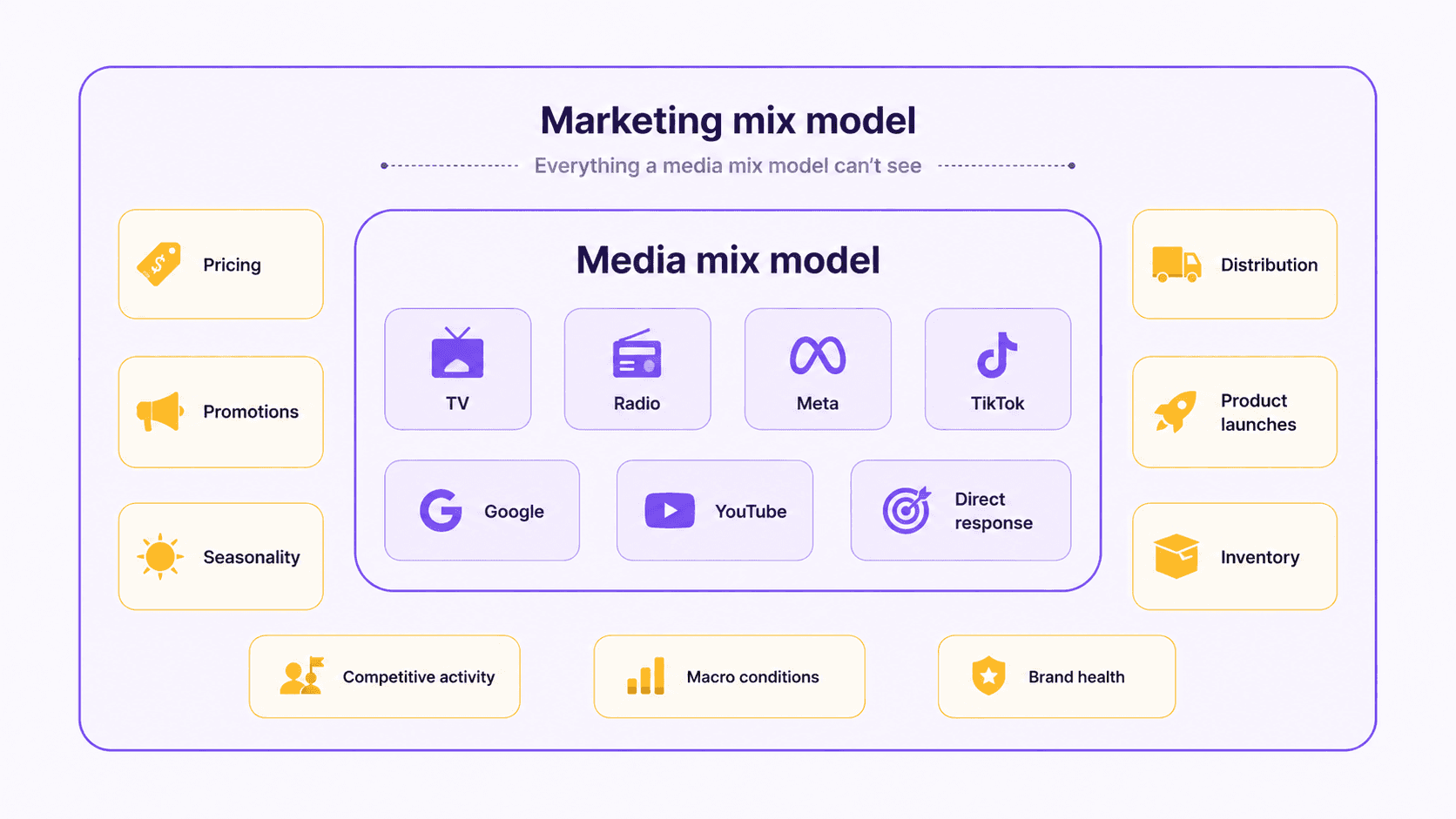
Media mix modeling answers a narrow question: how does spend allocation across paid media channels affect revenue?
It covers TV, radio, Meta, TikTok, Google, YouTube and direct response channels. Everything else sits outside it.
Marketing mix modeling is the umbrella. It asks a broader question: what drives revenue in total, and how much does each input contribute?
Paid media is in there, alongside pricing, promotions, seasonality, distribution, product launches, inventory levels, competitive activity, macroeconomic conditions and brand health. If it moves sales, it goes in the model.
Side by side:
Dimension | Media mix modeling | Marketing mix modeling |
|---|---|---|
Scope | Paid media channels only | All marketing + non-marketing variables |
Variables | Digital ads, TV, radio, OOH, DTC channels | Everything above + price, promos, seasonality, competition |
Best for | Budget allocation across media | Understanding all drivers of revenue change |
Time needed | 12–18 months of data typical | 24+ months, enough to capture seasonality and trend |
Typical users | Mid-market DTC, performance agencies | Enterprise CPG, retail, pharma |
Precision | High within media, blind to non-media factors | Lower on individual variables, high on total effect |
The consequence shows up when something goes wrong. If revenue drops 20% and you're working from a media mix model, last month's TikTok reallocation looks like the obvious culprit. The model can't tell you that a competitor launched a $50M campaign, that you raised prices 15%, or that a supply chain problem cut availability. Those variables were never in it.
A marketing mix model would catch them. It also needs more data history, a heavier implementation and a team willing to argue about what counts as seasonality.
Why does scope matter for your measurement strategy?
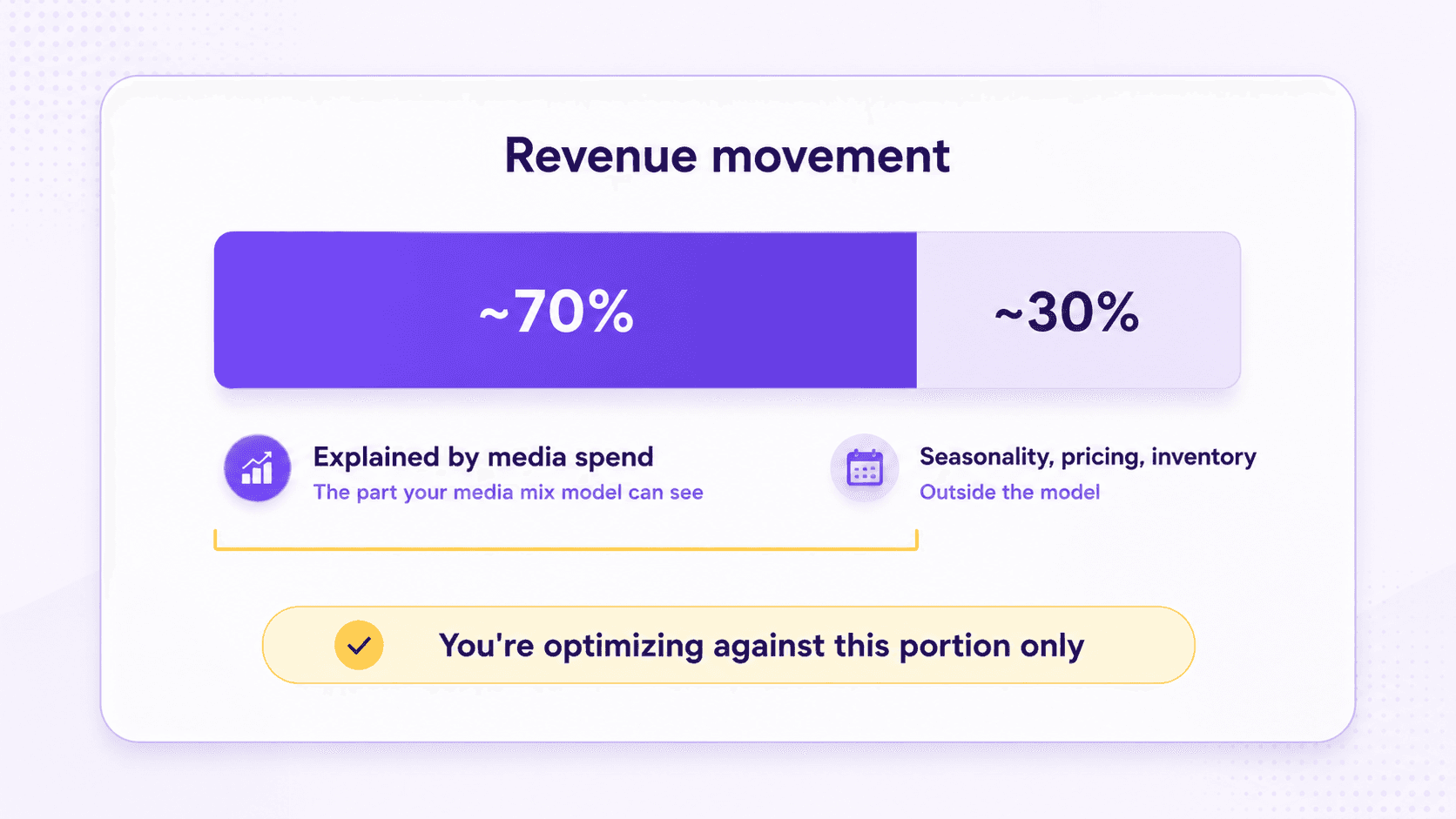
The operational problem is that your media decisions are only as good as the share of revenue movement your model can actually explain.
Say you run a DTC brand at $20M annual revenue across Meta, TikTok and Google. The media mix model puts Meta at 2x ROAS and TikTok at 1.2x, so you cut TikTok and move the budget to Meta. Reasonable on its face.
Now suppose 30% of your revenue swings come from seasonal demand, price testing or inventory constraints, none of which the model can see. You're deciding on partial information. You may have cut a channel that was performing fine and pinned a problem on it that had nothing to do with channel mix.
This is the part of marketing mix modeling for DTC that gets misread. Most DTC brands don't need a full marketing mix model. Paid media efficiency is their main variable and speed matters more than completeness, so a media mix model fits how they actually work.
That calculus changes once you're scaling into margin pressure, or running variable pricing, seasonal peaks and a real promotional calendar. Then you need the wider view.
Which approach actually fits your business?
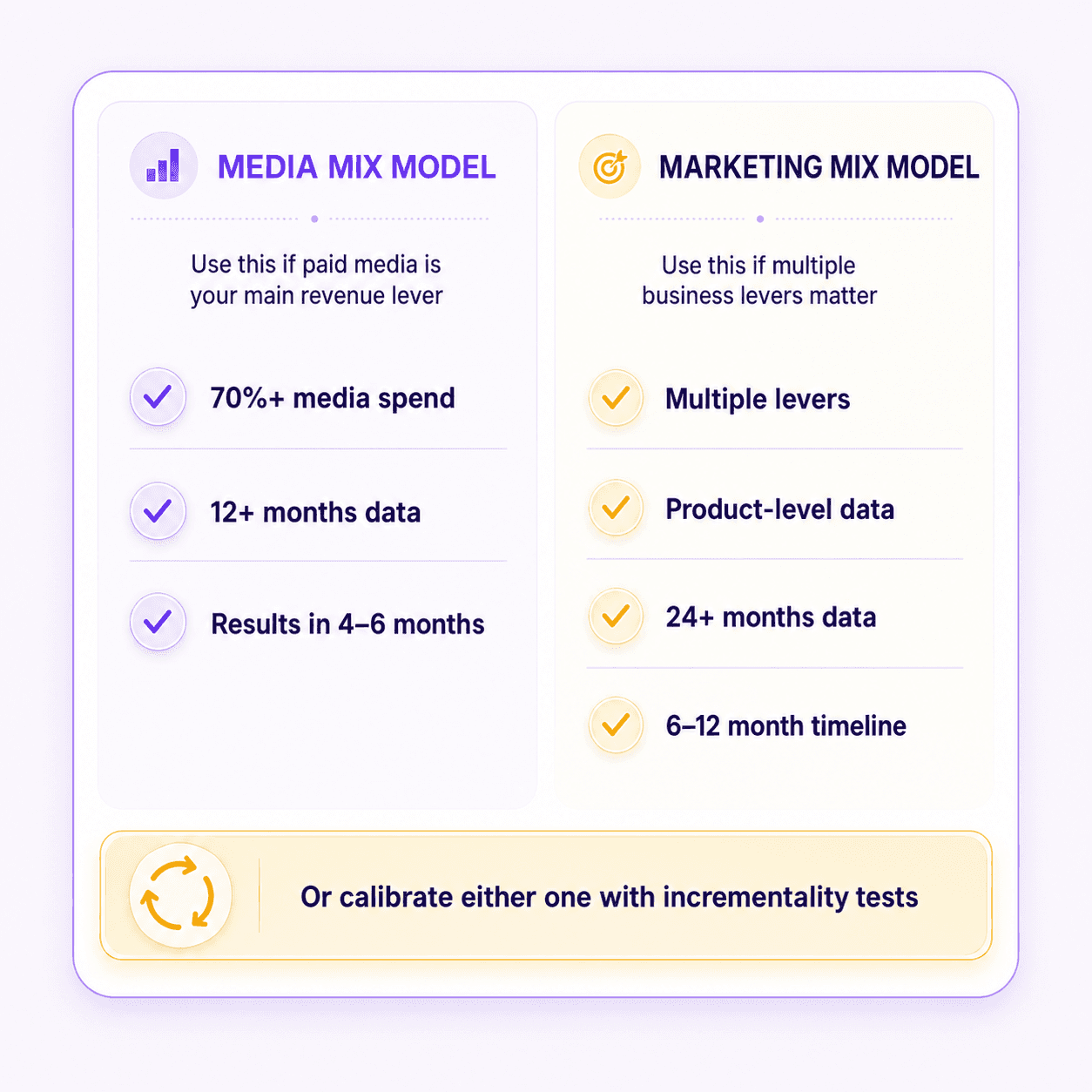
Use media mix modeling if:
You're a DTC brand spending 70%+ of your revenue-driving budget on paid media
Your main variable is channel mix and bid strategy
You have 12+ months of clean channel-level spend and sales data
You need results in 4–6 months
Your SKU count is small or your product mix is stable
Use marketing mix modeling if:
You're running a retail, CPG or enterprise brand with multiple levers price,promotions,distributionprice, promotions, distribution price,promotions,distribution
You have product-level sales data and non-media costs you want to factor in
You want to understand the total effect of your marketing beyond paid spend
You have 24+ months of historical data and can wait 6–12 months for modeling
Seasonality, competition or economic conditions shift your sales meaningfully
Most brands treat this as a binary choice. It isn't. Incrementality-calibrated MMM is a media mix model that gets validated and refined against incrementality testing results.
Incrementality tests, whether holdout, geo or time-based, show which channels drive incremental revenue. Those results feed back into the model and correct for attribution bias and channel overlap. The model stops estimating and starts working from effects you've measured.
David Protein, a Meta-heavy DTC brand, found their model was crediting Meta with 36% more revenue than testing showed was incremental. After moving to an incrementality-calibrated model, they reallocated with more precision and saw a 34% revenue lift alongside a 37% increase in profit.
How incrementality testing refines your modeling approach
Media mix and marketing mix models produce unreliable estimates for the same underlying reason: attribution confounding. When revenue moves, historical data alone can't tell you whether your media spend did it, a competitor went quiet, seasonality kicked in, or all three landed in the same week.
Incrementality tests isolate causation. A geo incrementality test or a holdout test deliberately holds everything constant except the variable you're testing, and the difference between test and control markets is your true incremental effect.
That result then becomes a calibration point. If your media mix model put Channel X at 10% of revenue and the test came back at 6%, the next refit corrects the estimate.
This is where causal MMM pulls ahead of pure statistical modeling. Causal approaches use experimental evidence and historical patterns together, which gets you the scope of marketing mix modeling with the precision of a test.
Frequently asked questions
Can a media mix model answer the same questions as a marketing mix model?
No. A media mix model is constrained on purpose, and it only looks at paid channels. Ask it why revenue dropped 15% when the real answer is a competitor campaign or a price change and it has nothing to offer, because those variables aren't in it. A marketing mix model would see them, at the cost of more data and more time. Choose based on which variables actually move your business.
Why would a DTC brand ever choose marketing mix modeling over media mix?
If your revenue volatility isn't driven mainly by media spend, and pricing, promotions, inventory or seasonality create the large swings, a media mix model will mislead you consistently rather than occasionally. Marketing mix modeling captures the full picture. The trade-off is cost, complexity and slower results.
Do I need both models running at the same time?
Most brands don't. Start with media mix modeling if you're DTC and media-heavy, then layer in incrementality testing to validate and calibrate it as you scale. If you reach the point where non-media factors like pricing, seasonality and competitive effects matter, graduate to marketing mix modeling. These are stages, not competing options.
What's the practical difference in how I'd use the results?
Media mix models tell you how to allocate budget between channels. Marketing mix models tell you how to allocate effort across every business variable. If the full answer is "raise prices 8% and shift media mix" and you only ever see the media half, you're acting on half the insight. That's what scope buys you.
Ready to move from guessing to ground truth? Book a demo to see how incrementality-calibrated models work in practice.